

When it comes to an Alzheimer’s care, all of the vocabulary, the stages, the realities and feelings that come with it can feel like a jumbled-up mess of alphabet soup. Between appointments and consults, caregiving, and seeking solutions to give your loved one the most fulfilling life possible, there is so much to keep track of. The fact is, Alzheimer’s is more common than you might think. As of 2026, 7 million Americans are affected. It’s not just impacting those of older age either. 2000,000 people under the age of 65 have been diagnosed with early-onset Alzheimer’s. And, according to Us Against Alzheimer’s, someone in the United States develops Alzheimer’s every 65 seconds.
We don’t share these facts and figures to scare you-we want you to know that you are not alone! Consider this a guide to help you understand the basics, anticipate what to expect when a loved one is receiving Alzheimer’s care, and the valid feelings and emotions that caregivers and family members might experience. We call this: The ABCs Guide of Alzheimer’s:
Alzheimer’s, what is it?
The technical answer: Alzheimer’s disease is a condition that gradually damages and destroys nerve cells in the brain. Symptoms that typically present include problems with memory and language, difficulty remembering recent conversations, names or events, communication problems, confusion, poor judgement and behavioral changes. As the disease progresses, difficulty speaking, walking and swallowing are also common.
The Brain chemistry is changing as the disease progresses. The 2026 Alzheimer’s Disease Facts and Figures research does a deep dive into the science and biomarkers that are causing the brain to change. Unfortunately, at this time, there is no cure. The research suggests that healthy lifestyle choices that support brain health can contribute to overall wellness and potentially delay the need for Alzheimer’s care. The lesson: It’s never too early to prioritize brain health!
The definition and the science alone can be a lot. But, when family members transition into the role of a Caregiver, dynamics and expectations shift and emotions are tested. In the U.S. today, nearly 13 million Americans provide unpaid care for a family member or friend with dementia. Caregiving can look like helping with one or more activities of daily living, such as bathing and dressing. Or managing other life needs for their loved one, like paying bills, organizing appointment schedules, issuing medications, communicating with healthcare providers, and relaying developments back to other family members. Not to mention also providing emotional support to the loved one receiving the Alzheimer’s care. You, caregivers, are superheroes!
One common question we hear from caregivers, especially after they receive their loved one’s initial diagnosis, is: What is the Difference between Dementia and Alzheimer’s?
The answer: dementia is a group of symptoms that consistently occur together, while Alzheimer’s is the brain chemically changing in an unfortunately irreversible (at this time) way. Symptoms of dementia include loss of memory, language, problem solving, difficulty concentrating, confusion and poor judgement or behaviors. This is very confusing because, as you read earlier in this post – the signs and symptoms are similar-that is why Alzheimer’s a type of dementia. The difference can be seen in the tests and scans that show the brain physically changing.
What is important to understand is that while an Alzheimer’s diagnosis can be an unexpected and unwelcome challenge, there are ways to encourage your loved one and help them thrive in this season of their life. Exercise and engagement are critically important for individuals receiving Alzheimer’s care. The Alzheimer’s Association recommends 30-35 minutes of aerobic, strength and flexibility exercise multiple days a week as well as brain exercise such as word puzzles or problem-solving games to keep the mind and the body sharp. While not a cure, these interventions that may delay the progression of the disease.
Another question we get: If my loved one has Alzheimer’s, does that mean there is Family History and I’ll eventually get it too?
The answer: Not necessarily. Family history does not guarantee that an individual will develop Alzheimer’s in older age, however, it is an important risk factor to acknowledge in your family medical history because, as research continues to search for a cure, there may be some genetic factors to be aware of.
Gee, we got the diagnosis … how are we supposed to feel?
After the initial shock subsides after a loved one’s confirmed diagnosis, family members and caregivers can quickly spiral into a long list of to-dos. How can I delay the progression? Make my loved one comfortable? And plan for what’s next? Let’s not forget to take a moment to breathe, find Hope, and think of ways that Independence is possible along this Journey. Hope in the fact that every year research is advancing and we are learning more and more about brain health and therapies that are supporting individuals receiving Alzheimer’s care and their families. There are also more tools, technology and resources available to individuals with Alzheimer’s today that is empowering them to participate in activities, stay engaged with hobbies and continue to spend quality time with their family members and friends.
The journey with Alzheimer’s is different for every individual and every family, however Keeping up with the progression/stages can bring great peace of mind and help family members recognize where their loved one might be at and plan for what is to come. The disease follows a predictable and progressive pattern: Preclinical stage, Mild or early stage, Moderate or middle stage, and finally Severe or late stage. For more, visit Johns Hopkins Medicine for what to expect and symptoms of each stage.
In the end, all of this research and seeking to understand what is happening to the brain chemistry of your loved one is all being done out of Love. It will require Mindfulness, Nurturing, Optimism and Patience and maybe even Quietly test the family members physically, emotionally and mentally-this season can feel very isolating. But, it’s important to remember that there are Resources. For example, at Country Meadows, we have host various support groups for individuals and families at various stages of the senior living experience. “Still Us” is a virtual and in-person support group for individuals navigating a partners dementia diagnosis. While, G.R.A.C.E is a caregiver support network focused on Guiding with Respect And Compassion for Everyone. Additionally, there are also many spiritual and secular supports that can be found in local communities that may be helpful for those navigating Alzheimer’s care.
These groups and resources are designed to equip family members and loved ones with the Tools to navigate the Alzheimer’s care experience. By embracing every moment, creating safe spaces and Understanding what is happening ensures everyone has a positive experience during visits or family events and activities.
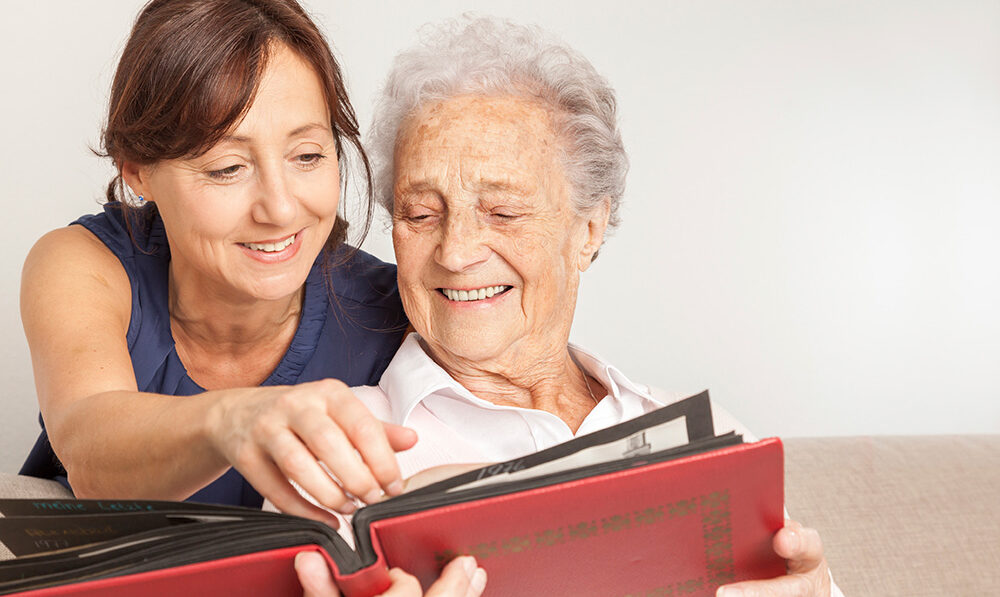
One of the tools we teach caregivers is the Validation Method. This technique recognizes that the individual experiencing memory loss may be doing or saying things that are counter to reality. Instead of trying to correct, it is more beneficial to enter his/her reality and listen and engage with your loved one with empathy. As the disease progresses, verbal communication may become more difficult, that’s where, as caregivers and family members, we can gain Wisdom in learning from each other and get creative in the ways we eXpress our love and support. Ok, we may have stretched those! But it’s true! For example, bringing family photos to visits, playing music that your loved one appreciates or doing crafts and activities that they once enjoyed can unlock a joy and a passion that you thought may have been lost.
We hope the takeaway from this blog is knowing that You are not alone. While Alzheimer’s care affects the entire family, there are supports for everyone on the journey. The diagnosis does not mean that life stops, every day is an opportunity to make memories that matter and encourage your loved ones Zest for life!
To learn more about how Country Meadows may be able to support you or your loved one’s Alzheimer’s care experience, contact a campus community near you. We look forward to showing you what a full and vibrant life can look like Connections Memory Support Services neighborhood.