

When she craves a few minutes of quiet, co-worker Robin Malloy, likes to visit with residents living in the in the Connections neighborhood—a secure neighborhood at Country Meadows of Hershey for residents with dementia.
“It’s always such a peaceful place,” she says. “It brings me a lot of joy to get to know the residents and hear their stories while they are still able to remember things.”
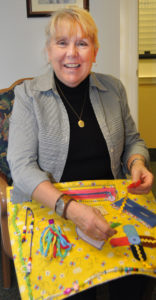
Robin Malloy with one of the fidget quilts she makes for persons with Alzheimer’s disease.
Malloy thought of the residents who have advanced memory loss when she discovered directions for making fidget quilts.
“I’m a long-arm quilter,” she says, referring to the special 12-foot sewing machine she uses to stitch quilt tops, batting and backing together. “So I was looking around for ideas to use up my fabric scraps. I saw the fidget quilts and was intrigued.”
Fidget quilts can help people who have Alzheimer’s disease and dementia cope with anxiety and restlessness. The quilts are about the size of a large placemat, 20” x 24,” with zippers, buttons, laces, ribbons, keys, small toys and/or beads securely attached to the fabric to provide a focus for restless hands. The quilts typically have a theme such as farming, animals, fashion or cooking, which is carried out through pictures on the fabric and may even trigger memories. Unique textures such as burlap, vinyl, and fake fur add to the sensory experience.
After talking with Shannon Harvey, director of Country Meadows of Hershey’s Connections Neighborhood for residents with severe dementia, Malloy made a fidget quilt prototype for her to review. Based on Harvey’s feedback, Malloy created three fidget quilts for the neighborhood’s residents.
“The quilts really do help. We keep about four on hand and the residents like to reach out and touch them as they go by,” says Harvey. “When we have residents in the latter stages of memory disease, it’s common for them to pick at buttons, grab things or engage in repetitive motions. We find it very helpful and soothing for them to spend time holding a quilt and playing with it for a while.”
It takes Malloy about two hours to create a fidget quilt. She carefully puts fabrics and items together to create a theme and layers the quilts with extra batting to give them weight when resting on a lap or a table.
“The important thing is to make sure that the items are fastened securely, so we’re not creating a safety hazard,” says Malloy. “We also want to make sure that they are easy to wash.”
With the success of her first three quilts, Malloy already is thinking about new themes like gardening and camping as she chooses fabrics for additional quilts. She sees potential for customizing quilts using materials printed with family photographs. And she has even purchased John Deere tractor material and a slinky to use on future fidget quilts.
“I’m kind of stockpiling ideas now. I’m always on the lookout for something that could be used as part of a theme or that would be good to fidget with–big buttons, unique fabrics, velcro,” says Malloy.
While the project didn’t use up her fabric scraps as she planned, in fact, it may have added to the materials Malloy keeps on hand, knowing that residents are getting pleasure from her quilts is very satisfying.
Robin,
Fidget quilts are a terrific idea for using fabric scraps and other accessories! Would you please share directions for making fidget quilts with me? Thank you in advance.
Donna Moyer
Robin does a great job with these quilts! We will share your email address with Robin. Good luck with your crafting.