

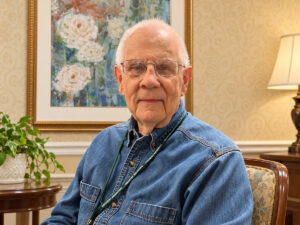
 Sometimes a single event can change life quickly; for Ben it was a fall. He had hit his head, experienced significant physical decline and was struggling cognitively as well. He could no longer walk unassisted.
Before that fall, Ben had been living at his home with his wife, helping care for her. Suddenly, he was the one who needed assistance. Even ordinary tasks such as washing his face, brushing his teeth, combing his hair or getting dressed required help.
In a relatively short period, Ben had to adjust to physical limitations, cognitive changes, and the eventual loss of his wife, the person who had been at the center of his life.
But Ben had one important thing working in his favor: he was determined to keep going. And Pathways Restorative Services™ at Country Meadows Retirement Communities was ready to help. Whether recovering from an injury or surgery or living with a chronic condition, Pathways embraces the life-affirming philosophy of focusing on individual abilities and encouraging the awakening of skills and talents.
Rather than doing everything for residents, the Pathways team focuses on helping each person continue doing what they can for themselves, building self-assurance and connections along the way.
Ben’s need was simple: get his life back
Ben’s earliest rehab care goals were not dramatic. They were deeply ordinary. He wanted to wash his own face. Brush his own teeth. Get dressed in the morning. Walk to the bathroom.
His recovery began with occupational and physical therapy (PT), but physical rehab was only one part of the process. The Pathways team continued working on his everyday routine, following medical and PT recommendations and helping him practice the skills he needed to care for himself in the most basic ways.
The goal was not to do everything for Ben. It was to give him enough support to help him do as much as possible without the help of a caregiver.
That distinction matters. In the Pathways program, Ben gradually relearned and strengthened everyday routines, including dressing, hygiene, toileting and moving safely through his surroundings.
At the same time, the rehab care team helped reinforce exercise and movement so the progress he made during therapy became part of daily life rather than something that happened only during scheduled appointments.
One step became the next
Progress came in stages. At first, Ben could stand and pivot for a basic transfer into a chair. Then he began walking to the bathroom. From there, he started walking around his room.
Eventually, he walked to meals. Each small accomplishment in rehab care opened the door to another. As his strength improved, Ben began moving farther through the community. He became more active, more social and increasingly independent.
Today, he can walk all the way to the end of the building and back. He goes to fitness activities regularly and participates in the daily life of the community. A typical day might include exercise, restorative activities or social programs. He joins outings, picnics and meals.
He participates in gardening, including planting and picking tomatoes. These may sound like simple activities, but that is part of the point. They require movement, coordination, decision-making, memory and social interaction. They are the building blocks of a productive and emotionally satisfying life.
Over time, the change became visible not just in how far Ben could walk, but in how he carried himself. As he began coming to meals, talking with other residents and smiling again, it became clear that he was regaining something larger than physical ability.
Finding his people
Ben’s progress also continued through one of the most difficult periods he faced: losing his wife. It would have been understandable for grief, physical limitations and cognitive challenges to overwhelm his momentum. Instead, Ben continued working on the ability to do things on his own.
His attitude helped carry him forward during his rehab care. He noticed small improvements and appreciated them. One accomplishment became motivation for the next. That persistence has become part of his story.
Today, Ben could potentially live in a different level of care on campus, but he has chosen to remain in Pathways. The reason is not simply the support he receives there. It is the community he has built around himself. These are his people.
He is connected to the residents and team members around him. He attends social activities, stays active and participates in the rhythms of everyday community life. Pathways provides additional support when his cognition makes certain tasks more difficult, while still protecting the mobility he worked so hard to regain.
Two years after arriving unable to walk self-sufficiently and needing help with even the most basic routines, Ben is active, social and engaged in his community. His life does not look exactly the way it did before his fall. But through persistence, rehab care therapy, daily practice and consistent support, he has built a life that feels like his own again.
And after everything he has faced, that independence may be the most meaningful transformation of all.